
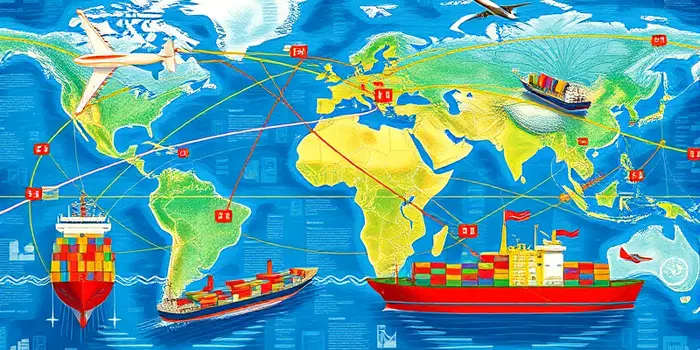
Global supply chains are evolving from straightforward procurement routes into strategic systems that shape a company's risk and opportunity profile. As geopolitical fragmentation, volatile trade policy, logistics chokepoints, and climate exposure converge, organizations must rethink traditional models in favor of more robust approaches.
This article charts a path toward a transparent, diversified, digitally monitored, scenario-driven model that balances cost efficiency with operational resilience and agility.
Once managed largely for cost and speed, supply chains now determine a firm's exposure to tariffs, conflicts, cyberattacks, labor abuses, carbon costs, and sudden demand shifts. The era of structural volatility demands an expanded view of procurement and logistics.
In 2025, tariff escalations among major economies reshuffled more than $400 billion in global trade flows, while container shipping costs rose 40 percent year over year. Meanwhile, global disruptions are estimated to cost businesses $184 billion annually, with 65 percent of companies facing at least one major bottleneck each year.
Geopolitical tensions are reshaping trade routes and supplier decisions. Conflict zones, such as the Middle East, influence energy flows, maritime insurance, vessel routing, and delivery reliability. UNCTAD forecasts slower global growth as uncertainty weighs on trade and investment.
Companies rarely exit regions entirely; they adapt through diversified sourcing and strategic contracts. Common tactics include:
Trade policy itself has become an operational variable. In early 2026, 72 percent of trade professionals cited U.S. tariff volatility as the most impactful regulatory change, compared with 41 percent the previous year. Tariff uncertainty influences product design, bill-of-materials decisions, inventory timing, and landed-cost calculations.
Despite overcapacity on major east-west routes, specific lanes and ports can become severely constrained. Red Sea disruptions forced many vessels around the Cape of Good Hope, adding days to transit times and spiking fuel costs. Meanwhile, labor disputes and severe weather events can trigger sudden bottlenecks.
Global ocean freight markets showed a 6 percent quarter-over-quarter rate decline in early 2026, yet average air-freight rates remained 32.2 percent higher year over year. These diverging trends illustrate that global freight capacity can be abundant overall while individual ports, carriers, or equipment types face critical shortages.
Companies must manage freight at the level of trade lane, port pair, mode, carrier, equipment type, transit-time reliability, customs performance, and total landed cost rather than relying on aggregate rate indices.
For decades, supply chains prized lowest unit cost, minimal inventory, and just-in-time replenishment. While these practices deliver high asset utilization, they also leave businesses fragile when conditions change rapidly.
A shift toward resilience involves deliberate trade‐offs: accepting higher procurement costs, maintaining strategic inventory, and qualifying alternative suppliers. A prudent approach is selective resilience, focusing investment where disruptions cause the greatest damage.
Front-loading inventory may temporarily hedge against tariff surges, but it carries its own risks—higher working capital, warehousing costs, and potential obsolescence. Front-loading inventory is a temporary hedge, not a complete resilience strategy.
Effective inventory management requires a shift from uniform safety stock to risk-adjusted inventory. Levels should reflect disruption probability, duration, financial impact, and qualification time for alternatives.
To help companies classify inventory, consider this breakdown:
By aligning inventory strategy with risk profiles, companies can maintain service levels without overinvesting in low-impact items.
Diversifying suppliers is fundamental to resilience, but nominal diversification can mask hidden dependencies. True robustness comes from effective diversification—where suppliers operate independently across geography, finance, logistics, and raw materials.
Key evaluation criteria include geographic exposure, financial stability, capacity, lead times, quality performance, cybersecurity maturity, labor practices, environmental footprint, and transparency into sub-tier suppliers. Companies must weigh the benefits of scale against the risk of concentrated exposure.
A balanced supplier strategy might involve a primary supplier for cost efficiency, a secondary supplier for continuity, an emergency supplier qualified for rapid activation, and strategic inventory to cover qualification periods.
To further mitigate global uncertainty, firms explore production strategies that bring manufacturing closer to key markets or trusted partners. Options include:
Each approach offers distinct advantages. Nearshoring reduces transit times and freight volatility, while friend-shoring addresses geopolitical alignment. However, companies must assess local labor costs, infrastructure readiness, and regulatory environments before committing.
In a world of complex interdependencies, digital tools are essential for maintaining end-to-end supply chain visibility. Advanced analytics, IoT sensors, AI-driven forecasting, and blockchain audits enable real-time risk detection—from component shortages to weather-driven disruptions.
Scenario planning transforms raw data into actionable strategies. By modeling alternative routes, supplier failures, tariff shocks, and demand fluctuations, organizations can stress-test their supply chains and build robust contingency plans.
Successful companies integrate scenario insights into decision-making, enabling them to reroute shipments, adjust production schedules, and reallocate inventory within hours rather than days. This agility turns potential crises into competitive advantage.
The tension between efficiency and resilience need not be a zero-sum game. By combining data-driven visibility, selective resilience, strategic inventory, and diversified suppliers, businesses can achieve both competitive cost structures and robust operational continuity.
In an era marked by structural volatility, embracing a holistic, scenario-driven supply chain model is not optional—it is a strategic imperative. Companies that adapt will not only survive disruptions but thrive in a dynamic global economy.
References