
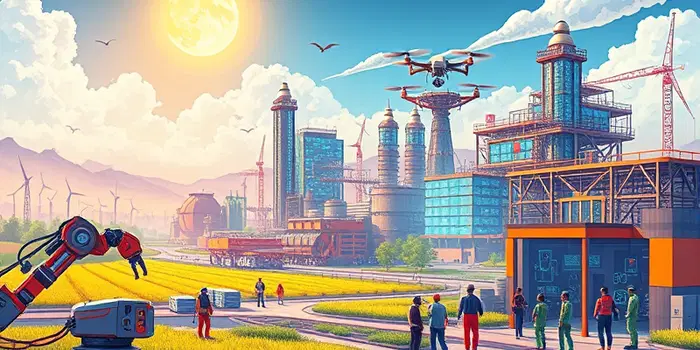
In today’s rapidly evolving business landscape, companies face a pivotal moment. No longer are digital tools isolated workhorses; they now form integrated systems that alter how organizations operate, compete, and grow. From manufacturing floors to cloud platforms, the synergy of advanced technologies is driving profound shifts across every sector. Understanding these transformations and preparing for their workforce impact is essential for leaders, employees, and policymakers alike.
At the heart of this revolution lies the fusion of multiple technology domains. Rather than single-point innovations, we see networks of innovations that amplify each other’s potential:
According to the World Economic Forum’s Future of Jobs Report 2025, by 2030 we can expect:
These figures highlight a complex reality: innovation can create jobs and displace roles at the same time. The report projects 170 million jobs created versus 92 million displaced, for a net gain of 78 million positions. Labour-market churn equivalent to 22% of today’s employment underlines the scale of change.
Artificial intelligence is no longer just a single-industry disruptor. It serves as an enabling layer across finance, healthcare, manufacturing, retail, and professional services. Generative AI has evolved from content creation to systems that interpret data, recommend actions, and coordinate workflows.
One of the most significant breakthroughs is agentic AI—systems capable of pursuing goals, planning tasks, and executing actions with limited human oversight. We can map AI evolution in five stages:
By 2026, Gartner estimated that 75% of enterprises are experimenting with AI agents. Yet, experimentation is just the start. True value emerges when organizations invest in workflow redesign and training, ensuring data quality, governance, and human oversight accompany new systems.
Industry snapshots illustrate AI’s breadth:
The AI boom is as much about hardware as software. Training advanced models demands high-performance processors, specialized AI accelerators, large data centers, and reliable power and cooling systems. McKinsey’s 2026 outlook reported AI-infrastructure spending doubled in one year, with nearly $200 billion invested in energy tech during 2025 alone.
This capital-intensive expansion has broad implications:
These tensions—geopolitical competition, grid constraints, water usage, and supply-chain dependencies—underscore that AI’s rise is deeply intertwined with global infrastructure and policy decisions.
Robotics is expanding beyond factory floors into warehouses, hospitals, farms, construction sites, retail outlets, and homes. The World Economic Forum expects robotics and autonomous systems to transform 58% of employers’ businesses by 2030.
Key robotics categories include:
Robot density has doubled over seven years, driven by a 40% cost decline in applications. Deloitte forecasts up to 2 million humanoids in workplaces by 2035, with a potential $30–50 billion market by then.
Robotics can eliminate repetitive tasks while boosting demand for specialized roles such as robot technicians, automation engineers, and human-machine supervisors. The net effect depends on how organizations integrate these systems.
Technological change need not be a zero-sum game. By 2030, the fastest-growing skill categories include AI and big data, networks and cybersecurity, and technological literacy. Organizations and individuals can embrace learning pathways, reskilling initiatives, and cross-functional collaboration to capture the benefits of innovation.
Policy makers play a pivotal role in ensuring equitable access to training and digital resources. Public–private partnerships can expand broadband connectivity, support workforce development programs, and foster research hubs that bridge academia and industry.
Leaders who view technology from a systems perspective—integrating new tools with human talent and robust governance—will unlock the most enduring value. In this moment of rapid change, proactive investment in people, infrastructure, and sustainable practices will determine who thrives in the next industrial era.
Innovation unleashed through convergence promises unprecedented opportunities. By recognizing the complex interplay of AI, robotics, clean energy, and digital access, we can shape a future where technology amplifies human potential and drives inclusive growth.
References