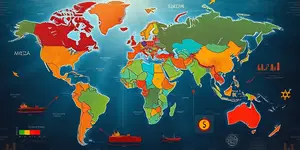

The global economy in late 2026 tells a story of resilience on the surface, yet beneath the broad indicators lies a far more intricate narrative. While GDP figures hover near long-term averages and equity markets maintain buoyancy, the lived experience of households, small enterprises, commodity-heavy sectors, and underserved regions diverges sharply. This split-screen reality reflects an environment where headline strength coexists with mounting undercurrents of stress.
In this exploration, we peel back the layers behind the numbers to reveal the forces shaping today’s markets. By examining borrowing patterns, sectoral performance, regional disparities, inflation dynamics, and labor market subtleties, we aim to equip readers with a deeper understanding and practical insights into navigating these hidden trends.
Major institutions project global growth near 3 percent in 2026, yet their forecasts diverge based on assumptions about energy prices, geopolitical shocks, and AI productivity gains. The OECD raised its outlook to 2.9 percent, crediting robust demand for technology, while the IMF holds close to 3 percent with caution over energy cost pressures. The World Bank is more pessimistic at 2.5 percent, highlighting weaker per-capita income growth in emerging markets.
These variations underscore a critical theme: narrow set of engines are sustaining headline numbers. Growth is not collapsing, but its benefits are unevenly distributed, and underlying vulnerabilities are accumulating outside the spotlight.
Two opposing forces define today’s economic backdrop. On one side, there is a surge of investment in AI infrastructure—from data centers and semiconductors to cloud networks and specialized equipment—fueling demand, innovation, and corporate revenue growth. On the other, a negative supply shock from energy has driven up costs for fuel, fertilizer, metals, freight, and utilities, squeezing margins and consumer purchasing power.
This duality produces a misleading veneer of strength: technology and capital-goods firms outperform, while energy-intensive manufacturers and cost-sensitive households feel the pinch. Equity markets rally on AI optimism even as real incomes stagnate for many and credit conditions tighten for small businesses.
Differences in global-growth projections are not merely academic; they influence policy decisions, investor allocations, and corporate strategies. Below is a concise comparison of key forecasts and their underlying assumptions.
These forecasts hinge on factors such as the duration of Middle East supply disruptions, the trajectory of oil and gas prices, real-world returns on AI spending, and the pace at which higher energy costs reach consumers and businesses.
Headline inflation may be cooling globally, but this does not translate into restored affordability. The OECD expects G20 inflation of 4.1 percent in 2026, with advanced economies at 3.2 percent and emerging markets near 4.8 percent. Yet even as price growth decelerates, consumers face ever-higher cost baselines.
This phenomenon—disinflation is not affordability recovery—means households experience lower inflation rates while battling permanently elevated price levels. Wage gains often lag, forcing many to rely on credit to sustain living standards and shift spending toward discount channels.
In the United States, second‐quarter GDP growth of 1.5 percent masked robust underlying demand: consumer spending rose 3.4 percent, and business fixed investment jumped 8.5 percent, driven largely by the AI build-out. Yet these numbers reflect a growing gap between income-supported and borrowing-supported spending.
Analysts warn of borrowing-dependent consumption, uneven labor demand, and declining savings rates as households tap credit cards, auto loans, and home equity to bridge the affordability gap. While retail sales remain firm, they may represent a lagging signal of weakening financial resilience.
Unemployment near 4.3 percent in the U.S. suggests a balanced labor market, but the Federal Reserve’s Beige Book reveals modest or flat hiring in most districts. Stable jobless rates can mask slow hiring, workforce churn, and an increasing share of precarious or part‐time positions.
Businesses cite energy pass-through, regional divergence, and input‐cost pressures as factors constraining expansion. With headline employment gains modest, wage growth may falter, adding to household stress and widening the gap between headline strength and lived reality.
Global growth is unevenly distributed. The U.S. and parts of Asia benefit from technology investment, while commodity exporters and energy-intensive manufacturers struggle. Europe’s exports and manufacturing show resilience, but ongoing energy costs weigh on household budgets. In emerging markets, food and fuel price spikes exacerbate existing structural challenges.
This divergence highlights the importance of granular analysis. Regional policymakers, corporate leaders, and investors must look beyond aggregate data to identify hotspots of strength and vulnerability.
Given the complex backdrop of narrow growth, uneven recovery, and rising risks, actors across the economy need practical approaches to thrive and mitigate downside exposure.
By aligning strategies with underlying trends rather than surface indicators, stakeholders can better manage risks and capitalize on pockets of opportunity.
The true measure of economic health lies not only in headline readings but in the broader tapestry of borrowing patterns, inflation experiences, labor dynamics, and sectoral performances. Uncovering these hidden market trends empowers businesses, policymakers, investors, and households to make informed decisions in a world where resilience is real but increasingly narrow.
As we look ahead, sustained vigilance, nuanced analysis, and targeted action will determine who thrives and who struggles in this split-screen economy. Beyond the headlines lies the path to a more inclusive, balanced, and durable growth story—if we choose to follow it.
References