
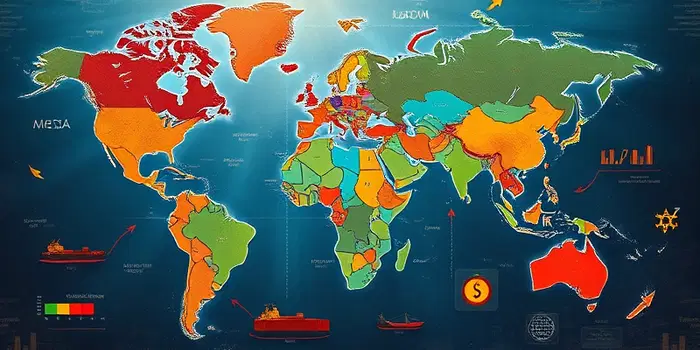
In an era of rapid geopolitical change, investors face a spectrum of risks and opportunities that can reshape their portfolios overnight. From sudden military flare-ups to protracted trade disputes, the ripple effects of every major event can be felt across equity, bond, commodity and currency markets.
When news of a diplomatic rupture or armed conflict breaks, markets often respond with higher volatility and market rotation. Equity indices may fall sharply, credit spreads can widen, and safe-haven currencies like the dollar or yen typically strengthen.
Research shows that the average monthly stock-market decline following a major geopolitical shock is about 1 percentage point across developed markets, while emerging-market equities drop roughly 2.5 percent on average. In the most severe episodes, such as international military conflicts, emerging markets can see declines near 5 percent in a single month.
Such short-term reactions, though daunting, often give way to more nuanced long-term effects. Over time, geopolitical risks can alter corporate earnings, reshape supply chains, influence inflation trends and ultimately change the relative attractiveness of regions and sectors.
Major events transmit through the global economy via multiple interconnected mechanisms. Understanding these channels helps investors anticipate shifts before they become fully reflected in asset prices.
Tariffs raise the cost of imported inputs and can erode corporate margins, disrupt consumer demand and force companies to redesign their sourcing strategies. During the 2025–26 period, global manufacturing saw a notable uptick in protectionist measures, adding to uncertainty about future trade rules.
Sanctions and export controls can be even more far-reaching. Restrictions on technology, finance, shipping or energy exports impose access to financial markets and technology constraints that ripple through related industries. Firms may face compliance costs, secondary-sanctions risk and reputational damage, all of which can erode valuations.
Supply-chain disruption has emerged as a central theme. Beyond cost-driven offshoring, companies now pursue risk management over cost-driven offshoring, duplicating plants, holding extra inventory and vetting alternative suppliers. While this bolsters resilience, it often comes with higher capital requirements and lower efficiency.
Energy and commodity shocks deserve special attention. Conflict near major production regions or transport corridors can trigger sudden price spikes in oil, natural gas, agricultural goods and industrial metals. These moves can turn into broader inflationary pressures, constraining central banks and squeezing corporate profits.
Finally, currencies shift as investors seek havens or reassess interest-rate expectations. Emerging-market currencies are especially vulnerable when nations carry high foreign-currency debt or have weak external buffers.
Armed with an understanding of these drivers, investors can take practical steps to protect and potentially profit from geopolitical volatility.
Adopting a proactive mindset—monitoring policy developments, tracking tariff announcements and evaluating country risk metrics—can turn uncertainty into an advantage. Investors who adjust position sizes, rebalance sector weights and maintain sufficient liquidity are better positioned to respond swiftly when events unfold.
While no portfolio can be completely immune to global shocks, a thoughtful, research-driven approach can temper losses and capture unexpected opportunities. By recognizing that military conflicts produce larger and more persistent effects and that diversified, resilient allocations often outperform during turbulent times, investors can navigate geopolitical headwinds with confidence.
In a world where politics and markets are inseparable, staying informed and disciplined offers the best path forward. Embrace the challenge, refine your strategy and let global shifts become a source of long-term strength rather than fear.
References